

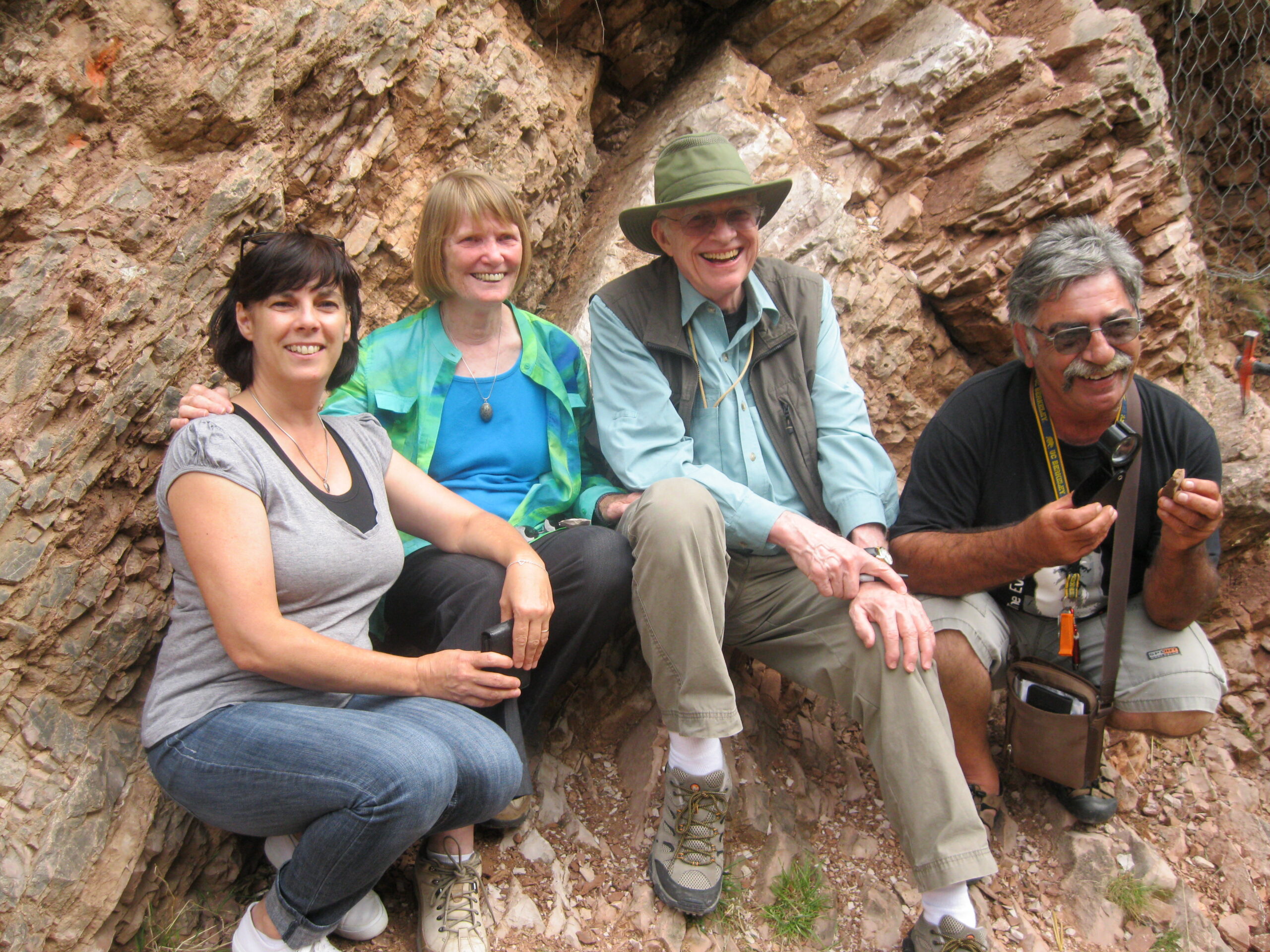
At first glance, this snapshot of science might seem to have backtracked. First, the story is full of false starts and abandoned goals: Alvarez’s work on plate tectonics was sidetracked by his intriguing observations of the KT boundary. Then his work on the timing of the KT transition was sidetracked by the iridium intrigue. The supernova hypothesis was abandoned when critical evidence failed to materialize. And now, scientists are wondering if the asteroid hypothesis can really explain the whole mass extinction. Our questions regarding the KT extinction have multiplied since this investigation began.
All that is true; however, we also have more knowledge about events at the end of the Cretaceous than we did before Walter Alvarez began poking around in the Apennines. We know that a massive asteroid struck Earth, probably near the Yucatan Peninsula. We know that no nearby supernova rained plutonium down on Earth. We know more about the fossil record surrounding the KT. We have a more detailed understanding of the climatic and geologic changes leading up to the end of the Cretaceous. In a sense, we have so many more questions simply because we know so much more about what to ask, and this is a fundamental part of the scientific enterprise. Science is both cumulative and continuing. Each question that we answer adds to our overall understanding of the natural world, but the light that is shed by that new knowledge highlights many more areas still in shadow.
The twists and turns in this story demonstrate that the path of science is nonlinear. Find out more about how the linear scientific method frequently portrayed in textbooks is misleading.
Learn more on Understanding Global Change about:
Use this story to introduce your students to the Science Flowchart. Check out the middle school or high school version of the activity.
Students can also review the story using this video.
Popular and historical accounts:
- Alvarez, W. 1997. T. rex and the crater of doom. Princeton, NJ: Princeton University Press.
- Rogers, P.W. 1979. LBL News Magazine. Available at http://www.lbl.gov/Science-Articles/Archive/
dinosaur-extinction.html
A few scientific articles:
- Alvarez, L.W., W. Alvarez, F. Asaro, and H.V. Michel. 1980. Extraterrestrial cause for the Cretaceous-Tertiary extinction. Science 208:1095-1108.
- Hildebrand, A.R., G.T. Penfield, D.A. Kring, M. Pilkington, Z.A. Camargo, S.B. Jacobson, and W.V. Boynton. 1991. Chicxulub crater: A possible Cretaceous/Tertiary boundary impact crater on the Yucatan Peninsula, Mexico. Geology 19:867-871.
- Renne, P.R., C.J. Sprain, M.A. Richards, S. Self, and L. Vanderkluysen. 2015. A state-shift in Deccan volcanism at the Cretaceous-Paleogene boundary, possibly induced by impact. Science 350: 76-78.
- Russell, D.A., and W. Tucker. 1971. Supernovae and the extinction of the dinosaurs. Nature 229:553-554.