

The start of the school year or semester is a good time to consider the general approaches and practices you will use to communicate the nature and process of science. You will likely want to begin by reviewing common student misconceptions about the nature and process of science, as well as common misconceptions about teaching these topics. You may also want to kick off the class with a starting activity that focuses student attention on how science works. Use the following suggestions to further orient your teaching throughout the year:
- Familiarize yourself with the Science Flowchart. This is useful background information for you, the teacher and facilitator. Identify the key components of the flowchart that are most appropriate for your students. At the K-2 level, you will most likely focus on components within the areas of Exploration and Discovery and Community Analysis and Feedback — though at second grade, you may begin to engage elements of Testing Ideas, as you help students see how their observations can be used to build explanations and answer questions. At the K-2 level, you have the opportunity to lay important foundations for your students’ understanding of the nature and process of science: engage their curiosity and build their skills in making observations, asking questions, and communicating what they have observed to others. In the Science Flowchart for K-2 below, the language and emphasis have been modified for your grade level. The flowchart can provide a guide for you to identify the skills you wish to make explicit with your students. Remember that not all science lessons that you teach need to include all of these components, but where there is a good fit, it is important to make them explicit to your students.
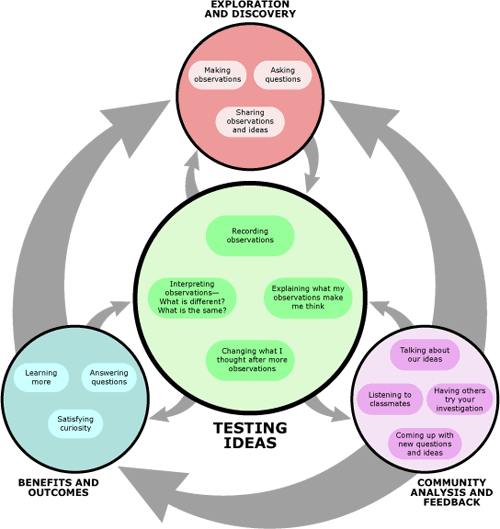
- Throughout the year, re-emphasize the same ideas in multiple contexts so that students can see the general applicability of these ideas to all of science.
- Be explicit about how your classroom activities and content relate to the nature and process of science (e.g., “When scientists want to learn about plants, they also look at them really closely and observe how they grow. Observing things carefully is really important in science.”).
- Wherever possible, get students to ask and answer “how do we know this?”
- Set the tone at the start of the year that science is creative, dynamic, and fun!
- Talk to other science teachers in your department, school, or district. How do they approach teaching about the nature and process of science? Try to coordinate efforts so that students receive a consistent and reinforced message.